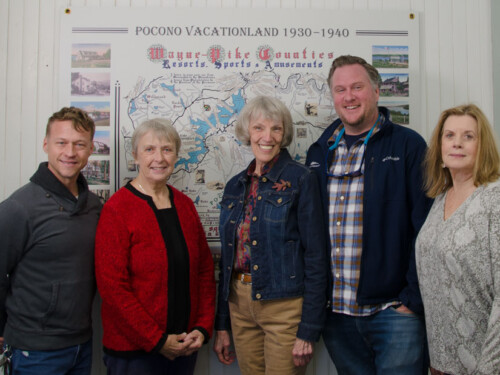
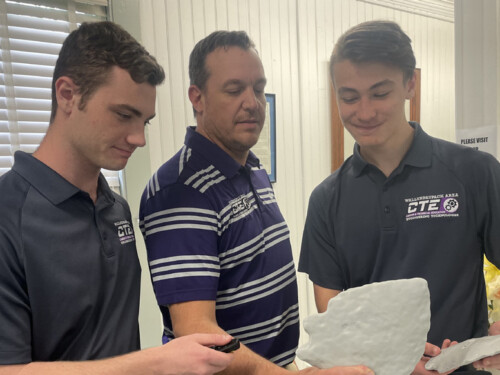
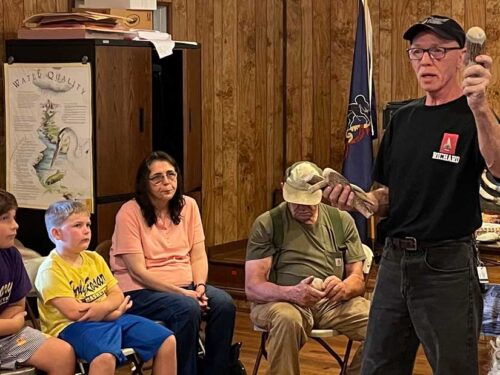
The presentation on September 9, 2024, by Diane Smith and Edward Quinter showcased a treasure trove of nineteenth-century letters written by pastors of the Hopedale Moravian Church in Newfoundland to their Bishop in Bethlehem. The letters give precious first-person accounts of life in the early settlement. Through a grant, the 700 pages of letters, dating from 1837 to 1878, have been digitized and translated and are now available online at the PA Power Library. German language professor Edward Quinter brought these fragile pages to life with his skill in translating Old German Script. He and GDHS historian Diane Smith presented the stories and information uncovered in the two-year project funded by a Historical & Archival Records Care [HARC] grant, awarded to the Historical Society in 2022.
Edward Quinter talked about the “pleasures and perils” of historic translation, as related to his work on the Hopedale letters. Quinter translated 40 of the of the total of 188 letters that were written in German. Of the total 246 letters, only 58 were written in English. “These letters give us an important glimpse into the joys and tribulations of the early settlers,” he says. But revealing those glimpses required working through smudges, careless handwriting, Latin mixed with German script, missing pages, poor penmanship, spelling inconsistencies, idioms, and faded ink. But the perks of Quinter’s work far outweighed the perils. In addition to the letters, preserved church registers and confirmation, death, burial, marriage and baptism records all provided precious information about these settlers. “These Hopedale records showed exceptional details that I could cross-reference,” said Quinter.
GDHS historian Diane Smith provided the local context for the letters. She described the Wallenpaupack Valley in the early nineteenth-century and the wilderness setting encountered by the first German immigrants to settle here. Diane’s description of the harsh winters, seasonal floods, illnesses and conflicts brought background for the audience. “The settlers persevered through poverty, crop failure, accidents, and diseases,” Smith said. The ministerial author of one letter admitted he had to “thaw the ink before I could write.” Winters were so cold that another pastor described the ice inside the parsonage.“ The pastors assigned to the Hopedale Church had to not only lead their congregations, they also had to farm the 50-acre church land, sell the oats and hay for income, facilitate product sales, and serve as the school teacher.” explained Smith.
“The settlers were tradesmen, not famers,” says Smith. “Now they had to survive on the land.” Yet learning to farm was only one challenge. Others included the flood of 1841, during which so many lost several years of preserved food. The pastors not only provided spiritual leadership through these ongoing struggles, they also helped their congregants learn to speak English, received and distributed mail, assisted with legal matters, mediated personal disputes, and facilitated financial transactions. “The overall story is one of success and perseverance,” says Smith, “especially through the guidance of Hopedale pastors.
For more about the early Newfoundland settlement and the mission church that was established there in 1837, see the article under “Local History.“